

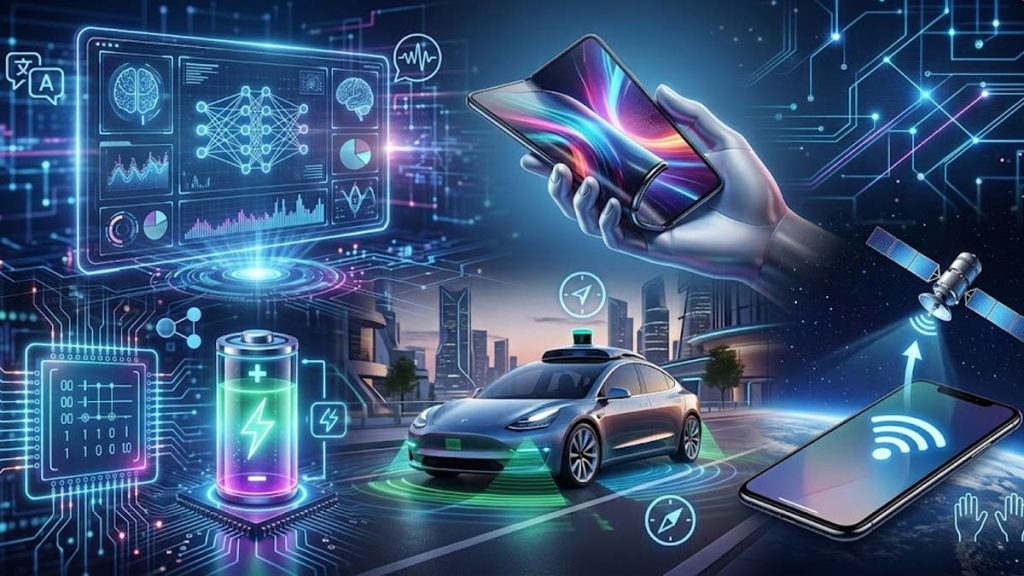
There was a time when the year 2020 and beyond represented a distant sci-fi dream. We imagined flying cars, fully conscious artificial intelligence, holographic displays, and neural interfaces that could bridge the gap between human thought and digital action.
While we might still be waiting on widespread flying commuter pods, the truth is that the future has quietly arrived. We are currently living in an era where everyday consumer technology and cutting-edge engineering routinely cross into territory that previously existed only in cinema and literature.
From devices that render human speech into foreign languages in real time to displays that fold like paper, here are 10 incredible pieces of technology available right now that truly feel like they came straight from the future.
1. Generative AI and Large Language Models
Not long ago, conversational AI was limited to rigid, pre-programmed voice assistants that struggled to understand simple context or basic accents. The rapid evolution of Generative AI has fundamentally changed our relationship with machines.
Modern AI platforms do not simply index information; they reason, synthesize, and create. You can ask an AI system to draft complex software code, compose a symphonic piece in the style of Mozart, or summarize a dense 50-page legal document in a few bullet points. The ability to engage in nuanced, fluid dialogue with a machine that grasps tone, subtext, and abstract logic feels less like software and more like interacting with a digital mind.
2. Foldable and Flexible Display Technology
For decades, digital screens were rigid glass slates. If you dropped them, they shattered. If you tried to bend them, they broke. Today, foldable smartphones and rollable displays have transformed hardware design entirely.
Using ultra-thin flexible glass and complex multi-link hinges, these devices allow a full-sized tablet screen to fold seamlessly in half and fit directly into your pocket. The engineering required to bend millions of pixels without damaging the delicate organic light-emitting diodes (OLED) underneath is nothing short of a modern miracle of material science.
3. Real-Time Translation Earbuds
The “Universal Translator” was a cornerstone of classic science fiction, enabling interstellar travelers to communicate effortlessly across language barriers. Today, that concept is sitting on store shelves.
By combining low-latency wireless audio, advanced cloud computing, and real-time neural translation, modern smart earbuds allow two people speaking entirely different languages to carry on a fluid conversation. As one person speaks in Japanese, Spanish, or Arabic, the audio is processed and delivered into the listener’s ear in their native tongue with only a fraction of a second in delay.
4. Consumer Spatial Computing and Mixed Reality Headsets
Virtual reality has been around in basic forms for years, but the latest generation of spatial computing hardware bridges the physical and digital worlds seamlessly. Using high-resolution passthrough cameras, eye-tracking sensors, and spatial audio drivers, these headsets overlay digital elements directly onto your real-world environment.
Instead of looking at a physical screen on a desk, users can project multiple massive virtual displays onto their living room walls, interact with 3D digital objects using simple hand gestures, or collaborate with lifelike avatars of colleagues across the globe. It effectively renders physical monitors and TV screens obsolete.
5. Commercial Electric Autonomous Vehicles
Self-driving cars were once considered a permanent fixture of a distant future. Today, fully autonomous taxi fleets are actively operating on city streets, navigating complex urban environments without a human driver sitting behind the wheel.
Equipped with an intricate array of LiDAR sensors, high-definition radar, spatial cameras, and deep-learning neural networks, these vehicles evaluate millions of data points every second. Watching an empty driver’s seat steer through heavy traffic, yield to pedestrians, and make split-second safety decisions remains one of the most surreal experiences of modern daily life.
6. Quantum Computing Cloud Platforms
While quantum computers are not sitting on individual office desks just yet, their accessibility via cloud networks brings the unimaginable processing power of quantum mechanics to researchers worldwide.
Unlike classical computers that process information in binary bits (ones and zeros), quantum processors utilize quantum bits, or qubits, which can exist in multiple states simultaneously due to superposition and entanglement. This allows quantum systems to perform complex chemical simulations, optimize global supply chains, and break cryptographic codes in seconds—tasks that would take traditional supercomputers thousands of years to compute.
7. Direct-to-Cell Satellite Connectivity
Losing cellular signal in remote mountains, vast deserts, or out at sea used to be an unavoidable reality of travel. Recent breakthroughs in satellite communication have eliminated these dead zones entirely by connecting everyday smartphones directly to low-Earth orbit (LEO) satellites.
Without requiring bulky external antennas or specialized satellite phones, modern smartphones can now send emergency distress signals, share precise location data, and even send text messages from virtually anywhere on the planet’s surface. It turns the entire globe into a connected workspace and safety net.
8. Bionic Prosthetics with Direct Muscle and Neural Integration
Prosthetic limbs used to be purely mechanical tools designed to restore basic physical structure. Advanced bionic limbs now feature direct integration with human nerves and muscle signals, allowing users to control robotic fingers and joints using thought alone.
Equipped with myoelectric sensors and microprocessors, these robotic limbs can detect tiny electrical impulses sent from the brain to the residual limb muscles. The microprocessors translate these signals into precise motor movements in real time. Furthermore, emerging haptic feedback technology now allows users to actually “feel” pressure and texture through their artificial fingertips.
9. Solid-State Energy and Ultrafast Charging Systems
Battery technology has long been the primary bottleneck for mobile hardware and electric transportation. However, recent advancements in solid-state battery chemistry and high-power charging architectures are changing the game.
New charging systems can now deliver power at unprecedented speeds, taking a dead smartphone or electric vehicle battery from nearly zero to full charge in just a few minutes. Additionally, solid-state batteries replace volatile liquid electrolytes with solid material, dramatically increasing energy density while virtually eliminating the risk of overheating or fire.
10. Desktop Neural Interface Controllers
Brain-computer interfaces (BCIs) are no longer confined to top-secret research laboratories. Non-invasive BCI bands and consumer controllers are beginning to enter the commercial market, allowing users to interact with software using brain activity and subtle nerve signals.
By measuring electroencephalogram (EEG) signals from the scalp or detecting subtle neuromuscular impulses along the wrist, these devices enable users to move digital objects, navigate user interfaces, or play video games without touching a physical keyboard, mouse, or controller. It represents the first step toward a future where human intention translates directly into digital action.
Key Takeaways
The boundary between science fiction and reality is moving faster than ever before. What makes these ten technologies so extraordinary is not just their technical impossibility from a decade ago, but the fact that they are actively integrating into our daily routines, workplaces, and consumer habits right now. As these systems continue to iterate and mature, the future will only continue to arrive sooner than we expect.
